EXTENSION/ADVANCED PREP TASK: record or find some spoken word, perhaps reading news articles or headlines. Add them all to individual bandlab tracks. Move and arrange volumes so you can hear them individually to start with and then all joined up and difficult to hear.
To compose for suspense and horror scenes, you need to think carefully about what kind of feeling you want the audience to have. And how might you achieve that?
When Bernard Hermann first started writing the music for Psycho, Hitchcock requested a jazz score, with no music in the (now famous) shower scene. Hermann thought that an orchestral, dissonant score would be far more effective. Do you agree?
Another useful technique is cluster chords, or 'tone clusters'. This is the term for a collection of at least 3 neighbouring semitones being played at the same time i.e, D, C sharp and C or A, Bflat and B. Giorgy Ligeti pioneered this technique in his score for Kubrick's 2001: A Space Odessey.
In the film, it accompanies scenes of open space, suggesting fear, being lost and perhaps claustrophobia.
However, sometimes less is more in film music. The use of 'found sounds' and minimalist techniques have been widely used by composers such as John Cage, Basil Kerchin and Alfred Schnittke. Found Sounds, such as clanking, scraping, dragging, can be very abrasive and un-nerving. John cage does this especially well in his piece, 'The Root of an Unfocus' which was used in the sound track to Scorcese's 'Shutter Island'. It appears at the start of a nightmare scene.
Found sounds are non-musical sounds such as breaking glass, environmental sounds or running water that can be used in music. They can be used either as they are or you can process them by adding effects, cutting, looping or reversing.
LISTEN: Look around you and listen. What does your environment sound like? If you have access to the outside, go out and listen (or open a window).
PLAY: Do you have any interesting objects that you can make sounds out of?
CAPTURE: Record these sounds (as you did for Tom & Jerry) and create a sample kit of your sounds
CREATE: try using these sounds (environmental and found) to write a track
It can be frustrating if you don't have access to instruments at home but music is sound so you can create your own! The music that you create will be completely original - no one else will be using these sounds. The limitations can also actually become opportunities and help you creatively.
In all Bond films, there is the MOTIF which consists of 2 main sections, which occurs at the start and end of the films and also as underscore when James Bond is lurking about, generally being Bond. The composers were John Barry and then David Arnold. You can find more info HERE
In most suspense music, there are massive DYNAMIC ranges, often punctuated by orchestral percussion such as timpani and cymbals.
Typical orchestration involves electric guitar, strings, brass, synths, percussion and occasionally high pitched wind instruments.
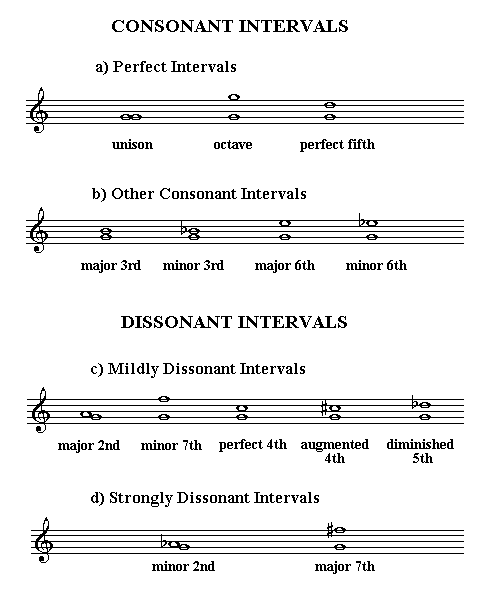
Harmonically, there is a lot of tension and release, meaning dissonance moving into consonance. See my other blog post about horror music and you can see examples of the intervals for both of these.
Melodically, there is also often a FIGURE that re-appears in various guises. It is a 4 note descending figure that sometimes appears as fragments (rather like Herrmann used fragments in a minimalist style). It also appears as a repeated figure, or OSTINATO.
A useful scale to use is the Aeolian scale which goes from A to A, only using the white notes. It is the natural minor scale so can be transposed to other keys easily but this is a good starting point if you are only just learning about key.
The following examples contain all of these compositional techniques:
TASK 1:
Using these techniques and suitable instrumentation, compose a Bond-esque theme! Bounce it as an mp3, upload to classroom and create a document explaining your process.
Listen to these pieces - do you know what they are from and what they represent?
Composers use melodic techniques to reel us in and emphasise certain points in films or help us to recognise characters.
Theme - a melody that is associated with a character or idea i.e The Imperial March, ET flying theme, Hedwig's theme....when we hear them in the film, we know that the focus is on that character.
Thinking of the techniques we have already covered, what techniques in each of those themes make them so effective?
We have already looked at Figure and Motif:
Figure - a short phrase, usually in the background, that is repeated.
Motif - a small section of a phrase that acts as a melody - often forming part of a longer theme.
What is happening melodically in the Jaws score?
The opening two notes in the Jaws score act as all three. It is a theme because we hear them and know Jaws is lurking about, a figure as it's just two notes that are repeated and it also develops into a fuller melody (motif).
TASK: compose a theme (melody line, no beats or loops please!) for one of the following fictional characters:
a heroic pirate
an alien
an evil child
a bird or a plane
Think about the techniques we have looked at (see previous posts if you need reminding) and choose appropriate instruments. The theme should be 8-16 bars long.
Cinema has come a long way since the early silent film of Charlie Chaplin, however, it is still all about storytelling. In today's digital world, storytelling has evolved and audiences are wanting to be a part of an experience more than ever before, rather than sitting on a seat watching a performance to be 'entertained'.
Secret Cinema provide this experience and their audience keep the secret.
You can see examples HERE Bugsy Malone Lawrence of Arabia TASK: Choose a film that you know really well and think how you would produce it as a secret cinema event. Copy this table onto your blog and label the post 'film music'.
FILM:
ARRIVAL OF AUDIENCE
ACTED SCENES:
LOCATION:
LIVE MUSIC:
INTERACTIVE ELEMENTS:
OTHER:
After presenting your ideas to the class, individually post your plan to your blog and label it 'film project'
Using child-like sounds (celeste, music box, glockenspiel...)
Contrary motion & Glissando- mimicking camera style
Short melodies - fitted with the fast cutting technique of the film
The new use of dissonant harmony
Using very few notes but putting them together in different ways - this was an early example of minimalism
Consonance & Dissonance:
One of the ways to create unease is to use DISSONANT HARMONY. A good explanation of this can be found on www.harmony.org.uk:
"Consonance and Dissonance
The way consonance and dissonance are treated is central to the way the whole of Western Music works and is the first concept to understand in the study of voice leading. It works on the assumption that consonant sounds are combinations of notes (intervals) that sound pleasant or melodious together whereas dissonant intervals sound harsh or unpleasant together.
Another way to express this is to say that consonant intervals create a feeling of stability whereas dissonant intervals create a feeling of instability that needs to be resolved. It is important to say that ideas of what constitutes consonance and dissonance have varied to some extent over time and vary from individual to individual. Also, it is important to say that most people perceive not just a simple binary division but a spectrum of consonance and dissonance varying from the most consonant intervals to the most dissonant intervals. The grouping below allows for this, to some extent, starting with the most consonant and ending with the most dissonant.
In 16th century polyphony, all musical intervals, involving two notes (within a span of an octave) are classified as consonant or dissonant according to the following list:
You will need to understand the naming and sounds of the musical intervals and the concept of "inversion" of intervals in order to follow this. Please refer to the books and website on basic theory in the bibliography"
Consonant music sounds 'nice' to the ear whereas dissonant music sounds un-nerving and less pleasant.
TASK: open a new bandlab project and experiment with these techniques. Using any pitched instrument, play a C and then the next semitone up at the same time (Csharp) - this is a minor second - is it consonant or dissonant? What about a C and a D? What about C and Dsharp (C and 3 semitones higher)? This is a minor third. Try this all the way back up to the C up an octave.
Please see the rest of the documentary (to the end from where we stopped) - we are creating Hermann style music tomorrow in Logic.
ACTIVITY: Watch a clip from a film or TV show and really pay attention to the diegetic sound (sound that you can see the source of on screen). Make a list of three on your blog and think about how they may have been created using foley. Look around you and see if you can find anything to re-create those sounds. We will demonstrate them when we come back.
Ennio Morricone wrote soundtracks for 'Spaghetti Western' films. His compositional style is easily recognisable by these elements:
Ostinato - he often uses a short repeated figure
Human voice - whistles and wordless singing are used a lot
Call and response - short motifs are used as call and response and are frequently repeated
Simple chords - the chords are consonant and simple and the melodies are also simple, often using triad arpeggios. (notes 1, 3 and 5 of a scale)
Silence and foley/musique concrete - there are moments where all music drops out and he often uses non-musical sounds such as whips and bells as rhythms
Electric guitar - Morricone was an early user of the electric guitar in film music in the 1960s
Task1: complete the quiz on classroom whilst listening to the sounds from the above clip.
Task 2: Download some suitable sounds from freesound.org and upload these to your drive. Use these to create a short piece of underscore in the style of Morricone that would be suitable for a Western and upload the mp3 to classroom to the library music assignment. Keep it simple!
Music plays a huge part in our understanding of a scene in a film and how we react emotionally. There are different types of sound in film:
Score - specifically composed music for the film, often matching up with the onscreen action (ie Harry Potter) Soundtrack - pre-existing music that is chosen to use in the film, accompanying scenes (ie Pulp Fiction)
TASK: Open two windows and go to YouTube in both. On the first window, find a clip from a film you really like. What is the music like? How does it affect the scene? Then find song in other window (or a movie scene with no dialogue). Mute the clip in the first window and what the scene now with the music playing from the second window. Find a few examples of this and post them on your blog.
Many film s had ‘intertitles’ which explained the action.
Music was always a major element – it was performed on a piano, guitar, organ or ‘mighty wurlitzer’ when special effects were needed. Some theatres even had orchestras. The music was either improvised or made up of classical repertory pieces. The cinema was the largest employer of musicians.
When ‘talkies’ came about, there was a decline in musicians’ being employed and a decline in the quality and popularly of film while people got used to it.
Neil Brand has collected some documents relating to how musicians worked in the cinema and uploaded them to his website HERE
TASK: - CREATE A MUSIC CUE SHEET FOR THE GREAT TRAIN ROBBERY. Add this to your blog and label it 'film music'. TEMPLATE (you will need t make a copy of this. You can then copy and paste it to your blog or add a link to your drive on your blog)
Music plays a huge part in our understanding of a scene in a film and how we react emotionally. There are different types of sound in film:
Score - specifically composed music for the film, often matching up with the onscreen action (ie Harry Potter)
Soundtrack - pre-existing music that is chosen to use in the film, accompanying scenes (ie Pulp Fiction)
TASK: Open two windows and go to YouTube in both. On the first window, find a clip from a film you really like. What is the music like? How does it affect the scene? Then find song in other window (or a movie scene with no dialogue). Mute the clip in the first window and what the scene now with the music playing from the second window. Find a few examples of this and post them on your blog. If you are stuck, here are some to get you started... https://www.youtube.com/watch?v=HtRGeyznv7k - Clockwork Orange